

Harmonics that’s not music to a farmer’s ears
THE right amount of rain at the right time, inputs at a decent price, hitting the ground when and where needed, healthy livestock, working machinery, good production and a fair price at market. That’s farming in harmony.


THE right amount of rain at the right time, inputs at a decent price, hitting the ground when and where needed, healthy livestock, working machinery, good production and a fair price at market. That’s farming in harmony.
It sounds ideal, although almost too good to be true. While it sounds like music to a farmer’s ears, ‘harmonics’ on farms, and in primary industries, is “not always a good thing”.
Adelaide-based harmonic mitigation firm Qub strategic business lead Aaron Grant – son-in-law of a Riverland farmer – hears only the dollars flowing out the farm gate when he hears those harmonics.
Mr Grant said he can sense when a farmer is unknowingly burning through profits by overlooking the health of the power their operation depends on.
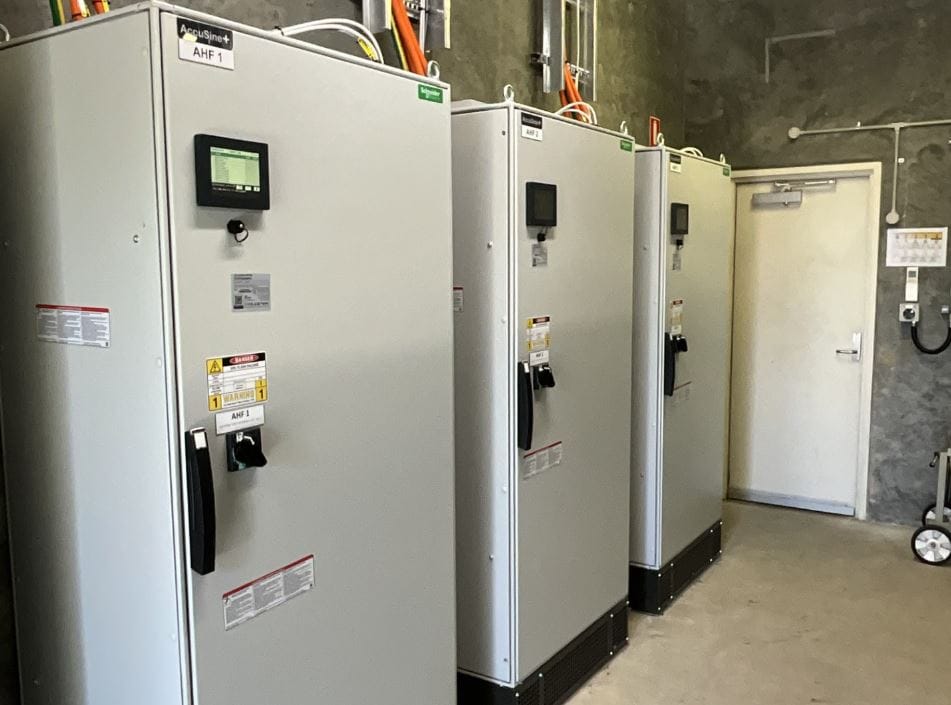
Mr Grant once “turned a farmer white with shock” when asking him to do the savings figures in his head after he flicked the switch on an automated active harmonic filter (AHF) unit that had sat idle for years, instantly taking eight per cent off the power use in his operation.
“I was standing there and could feel the heat of his drive and could hear the harmonics coming from it,’ Mr Grant said.
“The filter unit was not of great quality, but it had not even been commissioned because the installer did not know how to do that.
“I hooked it up and flicked the switch and within five minutes the heat had gone, the noise had softened considerably.’’
Agriculture has an ever-increasing reliance on power, easily the biggest cost for any operation and a service which, when it fails, carries risk that can be equal to any flood, fire or drought.
“A one second interruption to power supply can be just as damaging as an hour-long interruption depending on the site,’’ Mr Grant said.
“It is not linear, but when you get over an hour it can be an absolute financial disaster depending on what you are producing.
“In a dairy, you may have to clean out the lines because of bacterial build up, now you have got to make up that time because you’ve got trucks coming (and) they have to pick up the milk.
“You are an hour, two hours behind and you have the cows under stress. The list goes on.
“In such down time, the number one blame factor is the utility. But the point I make constantly is it is known that 80 per cent of power disturbances come from your own site.
“The default is that it is probably you to blame, and it impacts on the quality of power for your neighbours too.
“When we look at our sites, especially in the farming industry, it is so important to identify symptoms versus problems. What is the quality of the power pumping through that 355kW pump?
“Everyone focuses on the water, but what if you can’t get the water to the trees on a 40C, windy day? You’ve just reached the critical point; you’ve been five-years growing these almond trees and you’re now risking those five years of hard work all because we assume power and energy quality.’’

Almond operation manager Craig Best said Mr Grant “turned the tide of expense’’ for a large Riverland almond orchard by being attuned to power distortion and harmonics.
Running multiple Variable Speed Drives (VSDs) to co-ordinate pumps and watering across the large property, fluctuation in the power supply and harmonics, was contributing to a monthly power bill that hit more than $300,000, while pumps were breaking down with repair bills for each hitting $140,000.
“You can get a fluctuation in the power, so you can get a spike in the power,’’ Mr Best said.
“Aaron is so cluey at this stuff, (and) we got him in to look at ours. He looked at the harmonic filtering and he determined it was inadequate for what we were trying to do.
“He made some changes at a cost of around $45,000 for us to make the change. In the first month, the power bill dropped $100,000.
“But it is not just the power price, the pumps ran a lot sweeter… these pumps were a $2.5 million pump set up.
“I spent a significant amount of money maintaining pumps there. The power was so distorted at the end of the line that that was not helping the situation.
The pumps ran a lot better and hadn’t needed as much repair after that. I could see genuine savings from the outset.’’
Mr Best said he was now looking at power monitoring and harmonic mitigation at the operation he currently runs.
“We do have a VSD and I am looking at that, I believe there are massive savings to be made in power costs,’’ he said.
“The Riverland is very unstable in the way we take power. The distortion side of power is greatly unmeasured in these areas. There’s a lot of growers that pay excessive power bills that might not need to.
“A lot of the bigger companies are starting to realise that it’s more than saving money on power, they see the wear and tear on equipment they have from that unstable power supply.’’


